migraine fragment 2: the figure
Note: I am in the process of archiving my writings disperced across social media platforms on my own website here. This is a mirror post of “migraine fragment 2“ on my Substack page (cringe) processing.
Content note: This fragment contains descriptions of severe migraine pain, medical neglect, self-directed violence, suicidal thoughts and fantasies of death, and emotionally abusive family dynamics.
I’ve had a nasty migraine week with some new and bizarre symptoms. I’m not ready to process any of that with you all yet. But as I was journaling, my mind wandered and then lingered on one particular image that I am all too familiar with.
I see a figure in extreme pain.
Their head is bulging on the verge of explosion. One of their eye sockets hurts so deeply that they imagine digging the eyeball out. Their jaw, neck, and shoulders are tense like rocks. Their stomach is so unstable that they can’t tell whether they need to burp or throw up.
Their hands are constantly around their head and face, doing all sorts of things: finger massaging, scalp combing, knuckle rolling, hard squeezing, hair pulling, pinching, punching.
Sometimes they bang their head against the wall, trying to temporarily overwhelm one kind of pain by creating another.
None of it brings peace.
If only they could split their body in half. On days when the migraine attacks the left side, they could simply exist in the right. When it attacks the right, they could move to the left.
Sometimes the pain becomes so unbearable that death doesn’t seem like such a terrible possibility. At different points in this figure’s life, migraine has existed alongside fantasies about death and suicide—a dark reality of frequent, untreated pain combined with so many other forms of suffering.
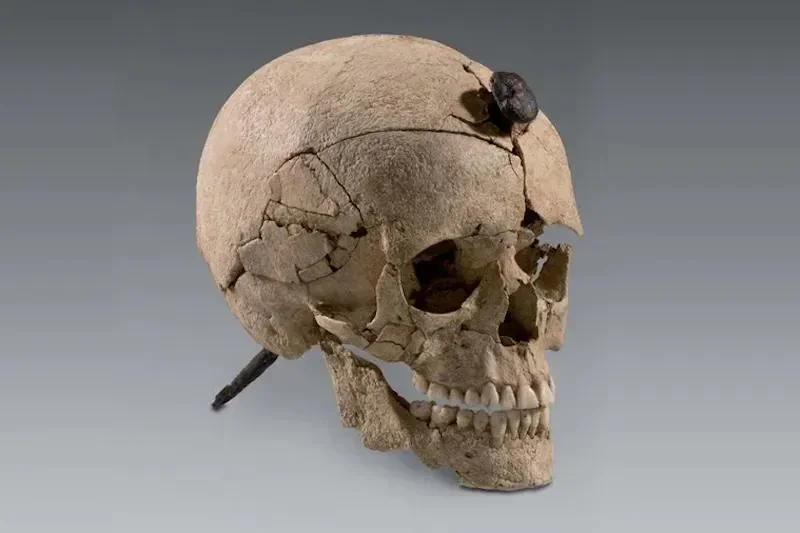
"For years, this 2,200-year-old nailed skull was thought to be a brutal war trophy. A recent isotope study revealed a wilder truth: it belonged to a local teenager, decapitated after death and nailed inside a home as a sacred guardian." (Blusky Post by @jordantyranny.bsky.social)
I know this figure well.
They are me.
This figure has accompanied me for years, taking shape most vividly during my adolescence. They have changed as I’ve changed, but my clearest and most intimate memories come from ages thirteen to eighteen, when I was living at home with extreme migraines that went untreated and were explained away as consequences of my bad posture.
Growing up, I often felt a slap on my upper back.
“Aya! Don’t slouch. Sit up straight.”
At first, I told my parents when my neck and head hurt.
The response was almost always the same.
“You just need to sit up straight.”
Or worse, telling them I was hurting invited an investigation into what I had done wrong.
“Why do you sit like this?”
“Why is your head tilted?”
“Why are your shoulders uneven?”
“Did you remember to drink hot water?”
There was little curiosity about what I was experiencing. Instead, pain became another problem for me to correct.
Eventually, I learned the lesson.
Don’t tell them.
If I could hide an illness, I would.
I had already learned from a young age that needing care could come with nagging, blame, or yelling. I remember hiding my worsening eyesight for perhaps a year, squinting my way through the world until eventually I couldn’t hide it anymore. Every time my prescription increased, the familiar questions returned.
“Why do you sit like that?”
“Sit up straight!”
“It’s because you do your homework in bad posture.”
Eventually:
“We are spending so much money giving you the best glasses. Can’t you just sit up straight?”
My acne became another battleground between my body and their need to fix it. I will save this extremely painful chapter of my life for another day.
Migraine was different because, at least initially, it was easier to hide.
A headache is invisible.
A neck ache is invisible.
Nobody looking at me could necessarily see what was happening inside my skull.
Painkillers weren’t an option in my household, so I learned to tough it out. Drink the magical hot water. Sit up straight. Keep going.
And I wasn’t dumb.
I had learned what happened when I reported something wrong with my body.
So I stopped reporting it.
Unless the migraine became so severe that I couldn’t get out of bed—unless my pain made itself visible—I tried not to say anything.
For helicopter parents, my parents knew remarkably little about important parts of my life. Their attention could be everywhere while somehow missing what was happening inside me.
As the headaches and neck aches went untreated, my migraines became more aggressive: intense head pain, neck pain, nausea, and all the other sensations I didn’t yet have language for.
I became very good at faking being okay in front of my parents.
I could let go only at school or alone in my room, supposedly “doing work” or “sleeping.”
I remember sitting in class with my forehead resting on my forearms on the desk. Sometimes, if I’d brought a pillow for the lunch nap period, I could put my head on that instead.
I had no idea what was happening in class.
I was just trying to survive.
I’d fidget and change positions over and over, searching for some configuration of my body that might offer even a little relief. But I was at school. I couldn’t make noises. I couldn’t do all the strange things I wanted to do to my head. I couldn’t bang it against the blackboard. I couldn’t ask a friend to somehow pierce through my skull and release whatever was happening inside.
So I put my head down.
And waited.
A couple of classmates knew about my headaches and sympathized with me. One of them experienced headaches too. They told me their mom had taken them to someone for treatment and that it had helped.
Their mom took them somewhere because their head hurt.
I didn’t tell my parents about that conversation.
Of course I didn’t.
Looking back, I’m also struck by how no teacher seemed particularly curious about the student repeatedly putting her head down on the desk.
There were so many adults around me.
And yet I don’t remember having an adult who felt like a safe place to bring my pain.
Yes, I’m angry.
I’m enraged for the younger version of myself who was left alone to survive this pain while simultaneously trying to thrive at school, complete afterschool classes and mountains of homework, and become the daughter my parents wanted me to be.
My body hurt.
My head hurt.
My neck hurt.
My stomach hurt.
And eventually there were all the other kinds of hurting that aren’t as easy to point to.
Sometimes I wonder who I might have become if I’d grown up with emotional safety. If I hadn’t needed to be hypervigilant so young. If physical and emotional discomfort weren’t things to hide. If I hadn’t learned that sometimes abandoning myself was easier than risking somebody else’s reaction.
What if somebody had been curious?
What if, instead of deciding that my headaches were caused by my posture, somebody had asked what the pain actually felt like?
What if we’d gone to a professional?
What if I hadn’t internalized the explanation that something I was doing wrong—my posture, my neck, the way I sat—was responsible for my suffering?
If.
If.
If.
And suddenly I’m thinking again about that stupid pain scale.
On a scale from one to ten, how would you rate your pain?
Fifteen years of migraines, and I couldn’t answer.
Of course I couldn’t.
For years, I had been practicing something else entirely.
Instead of noticing pain, I learned to ignore it.
Instead of expressing it, I learned to conceal it.
Instead of asking for comfort, I learned to tough it out.
Instead of asking for help, I learned to stay quiet.
Instead of trusting what my body was telling me, I learned to search for what I had done wrong.
Pain carries so many emotions with it. Fear. Anger. Grief. Loneliness. Helplessness.
But I grew up in a family where even crying could be unacceptable. Being positive, respectful, high-achieving, and being the daughter who could make my parents proud mattered enormously.
So I became very good at suppression.
I became very good at convincing other people that I was okay.
Maybe I became very good at convincing myself, too.
I was never taught to sit with pain. I wasn’t taught to listen to it, comfort it, or coexist with it. I wasn’t taught how to attend to myself or recognize what my body was trying to tell me.
I wasn’t even allowed to cry.
So perhaps I shouldn’t be surprised that all these years later, a doctor can look at me and ask:
On a scale from one to ten, how much does it hurt?
And somewhere inside me, the teenager with her forehead pressed against the desk is still answering:
I don’t know.